Thursday, December 16, 2010

Future Technology

 Enhanced Geothermal Systems

Enhanced Geothermal Systems 

The overall objective of Enhanced Geothermal System (EGS) is to harness the heat naturally generated by the Earth to produce electricity. In order to do so, wells are drilled into high temperature basement rock which is naturally fractured. The fracture network is enhanced to create a reservoir into which additional wells are drilled. Cold water is then pumped into the fracture network, via the wells, absorbing the heat of the rock as it passes through. As it surfaces in the connected wells, the heat is captured and converted into electricity via steam turbines and the water is released back into the fracture network to be reheated.

Successes at EGS projects like in Australia, where they achieved a third to a half flow capacity after drilling into 250°C rock four kilometres below ground, have been encouraging. EGS is a base-load resource, which gives it the ability to produce power 24 hours a day. It is also economically viable as it costs less to set up an EGS operation than to set up a new clean coal burning power plant.


Concentrated Solar Power

Another alternative solar energy technology is Concentrated Solar Power (CSP). Similar in concept to the ancient 'burning mirrors' used by the Chinese back in 700BC, this modern version takes the form of solar farms in which multiple rows of mirrors concentrate the sun's rays onto a fluid-filled vessel, which in turn powers generators or steam turbines.

Building solar farms in many countries is not a viable option for obvious reasons; however the Spanish, Moroccan, Algerian and Egyptian governments are starting to invest in the development of CSP plants. It is said that each year the desert receives the solar energy equivalent of 1.5 million barrels of oil per square kilometre, making CSP a very feasible alternative energy source.
Once these plants are up and running, it would be possible to import the energy from Africa to Europe via a high voltage direct current (HVDC) super grid. These grids would be a great improvement on the existing grids as they only lose around 3% of the power per 1000km, compared with the approximate 50% loss on the current HVAC grids.

Concentrated Solar Power definitely seems the most likely way forward in producing cost effective and clean renewable energy. So far support, at least amongst European countries, is growing and it is quite possible that in the near future Europe will gain a more efficient electrical super grid, transporting solar power originating from North Africa.

Wednesday, December 15, 2010

Future Cars

Future cars are here again, the sky above is blue again! Okay, so I'm a little excited about the future cars that will grace our highways and byways and even skyways one day. While some future cars may be just a part of science fiction, there are many that are real in concept or prototype and on the leading edge of science.
Future Car
The future car is here, now! At least most of them are. It's amazing how many future cars exist today, from hydrogen to electric and biofuel vehicles to even flying cars. It is the intention of the site to cover all sorts of future cars, from those that exist today to the ones that are still on the drawing boards.
Of course, no one uses a drawing board today. That is so last year. Today, future cars are conceived on the computer in great detail. These future cars are actually concept vehicles, which have yet to be built. Once built, the future car is considered to be a prototype.

If a future car actually does move from concept to prototype, then the next step is for it to become a production vehicle. It is at this point that a future car is no longer considered to be so since it has arrived as a regular production model that anyone can buy. These are not the cars, however that will be featured on this site, unless, that is they happen to make it all the way from concept to production over the next several years.

The future cars we're concerned with are the concept and prototype vehicles that may one day make it to the showrooms, though most will not. Even though most future cars will not make it into the showrooms, they are valuable to many since they exhibit the possibilities for the future.

Design, architecture and powertrain technology in future cars can be drastically different than anything seen on a typical car lot. And, this is the way, many fans of concept and prototype vehicles like it. For instance, there have been a few wild hydrogen car prototypes that are of interest to future car fans, but are too expensive an impractical for everyday drivers.

Like science fiction, future cars fulfill a void in today's society. This kind of automobile gives people the room to dream, invent and create. There are so few restrictions on the future that one can let one's mind run wild and dream big when it comes to what the cars of the future will look like.

Wheels, turbo, electric, hydrogen, nuclear, wings, cockpit, 360 rotation, crash avoidance, smart communications with traffic signals - some of the technology is here now while others is just budding.
This is why future cars are so popular and why we wish to present a site devoted to the dreamers, inventors and creative types who wish to entertain all the possibilities of what the future for the automotive industry may hold.


This is why future cars are so popular and why we wish to present a site devoted to the dreamers, inventors and creative types who wish to entertain all the possibilities of what the future for the automotive industry may hold.


Tuesday, December 14, 2010

Future Green Ideas

1. Hotel offers free meal to guests who are willing to generate electricity


Cafundo

The Crown Plaza Hotel in Copenhagen , Denmark , is offering a free meal to any guest who is able to produce electricity for the hotel on an exercise bike attached to a generator. Guests will have to produce at least 10 watt hours of electricity – roughly 15 minutes of cycling for someone of average fitness. They will then be given meal vouchers worth $36 (26 euros).

2. Disco pub gets electricity produced by people dancing at specially modified dance floor


Cafundo

All the flashing strobes and pounding speakers at the dance club are massive consumers of electrical power. So Bar Surya, in London, re-outfitted its floor with springs that, when compressed by dancers, could produce electrical current that would be stored in batteries and used to offset some of the club’s electrical burden. The club’s owner, Andrew Charalambous, said the dance floor can now power 60 percent of the club’s energy needs.

3. Brothel offers discount to eco-friendly customers who use bikes


Cafundo

A Berlin brothel came up with an innovative way to attract customers during the economic crisis, and do something to help avoid climate change at the same time. They’re offering a discount to patrons who arrive on bicycles. According to Thomas Goetz, owner of the ‘Maison d’envie’ brothel, the recession hit their industry hard. Customers who arrive on bicycle or who can prove they took public transport get a €5 (£4.30) discount from the usual €70 (£60) fee for 45 minute sessions.

4. Company creates a desktop printer that doesn’t use ink nor paper


Cafundo

Who says printers only use paper to print documents? It’s time for you to meet the PrePeat Printer then. Different from conventional printers, PrePeat adopts a thermal head to print on specially-made plastic sheets. These plastic sheets are not merely water-proof, but could be easily erased, just feed the sheets through the printer again, and a different temperature will erase everything or just write over it. Also claimed by the manufacturer, such one sheet could be used up to 1,000 times so that you’ll reduce your expenses on paper for sure.

5. University constructs a green roof as a gathering place


Cafundo

Green design is an enormously popular trend in modern architecture, just take a look at this amazing green roof at the School of Art , Design and Media at Nanyang Technological University in Singapore . This 5-story facility sweeps a wooded corner of the campus with an organic, vegetated form that blends landscape and structure, nature and high-tech and symbolizes the creativity it houses. The roofs serve as informal gathering spaces challenging linear ideas and stirring perception. The roofs create open space, insulate the building, cool the surrounding air and harvest rainwater for landscaping irrigation. Planted grasses mix with native greenery to colonize the building and bond it to the setting.

How Saturn's Ring is formed.

A team of astronomers challenges the established idea that Saturn's massive rings formed when a comet passed too close to the planet, or when such a body struck one of its moons. The new idea holds that the structures appeared as a result of a collision between Saturn and a very large moon.
The group believes that, in order for a natural satellite to create such outcomes, it would have had to be at least the size and mass of Titan, currently the largest moon around Saturn. The rings are basically the final shards of the ancient collision.

According to the new calculations, the collision took place an estimated 4.5 billion years ago, when events conspired to see the large moon spiraling towards its parent planet. As it did so, gravity began exerting its effects on the celestial body.
Astronomers now think that most of this object was made of ice, which is not impossible, if considering the Saturnine moon Enceladus and Jupiter's Europa, Space reports.

As such, during its final approach to Saturn, strong gravity began destabilizing its structure, eventually forcing it to shed its icy, outer layers, which were mostly made up of ice.

The researchers say that the rings we see today are in fact pieces of what was once the surface of this Titan-sized moon. This model also helps explain the chemical composition of the circular structures.

What made it difficult for planetary scientists to propose explanations for how the rings formed was precisely their chemical composition, as the formations have a water-ice content of 90 to 95 percent.

Given that contamination occurs over time, experts believed it was safe to say that all of them were made of pure water-ice when they first appeared. Only two explanations for their existence were seriously considered among scientists.

One holds that the rings appeared following a collisions between a comet and a Saturnine moon, while the other says that they were formed after the planet's gravity ripped apart a comet that came too close.

The new model “implies that the rings are primordial, that they formed from the same processes that left Titan as Saturn's only large satellite,” explains investigator Robin Canup.

“And it's the only self-consistent explanation for the ice-rich inner satellites,” adds the expert, who was the author of the new study. She holds an appointment at the Southwest Research Institute (SwRI), in Boulder, Colorado.

“Other theories have struggled to explain an initial ring that was essentially pure ice. That's a very unusual composition,” the expert goes on to say.

The existence of another Titan-sized moon is supported by the fact that Jupiter has four large moons rather than one. Saturn may have had more than one or two in its heyday as well.

One of the most important consequences of this idea is the fact that it provides an explanation for the very existence of the gas giant's icy inner moons, which standard models cannot readily explain.

Tethys, Enceladus and Mimas are all good examples of such bodies. They may have formed as ice particles from the rings started moving outwards. Those that moved inwards were “eaten” by Saturn.

“The other theories have the rings forming from a sort of random event. This model reduces the number of things that have to happen, which I think makes it more probable,” Canup explains.

Monday, December 13, 2010

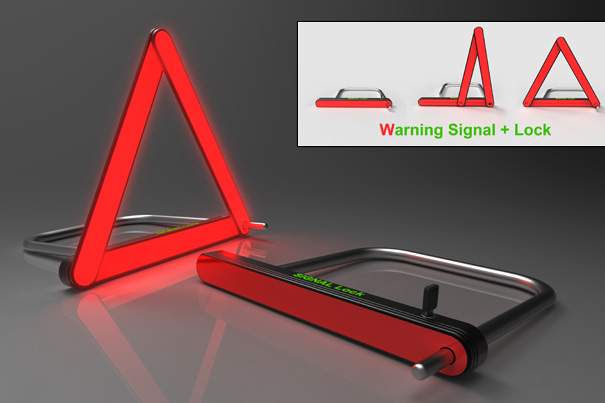
A Fair Warning.

Signal Lock is an LED warning light that fits within the frame of a bicycle and comes in real handy when you’re stuck in the middle of nowhere. Sure we can move the bike off the road to avoid an incident, but this is being better safe than sorry. It would be hip to repair your cycle with a LED warning light beaming your presence and distress from a 100 meters away anyways.


Designer: Chen Guan-Yuan

Citizen's Memory LCD

Citizen has developed something it's calling the "memory liquid crystal," a new passive matrix LCD that can retain an image even when powered off. According to Citizen, the display's inorganic membrane, combined with an angled orientation, keeps the crystals frozen in position without power having to be maintained. The five-volt, non-backlit display isn't going to take the place of your LCD TV anytime soon, but is planned for use in point-of-sale applications, watches and cellphone auxiliary displays.

Can the World Be Powered Mainly by Solar and Wind Energy?

Continuous research and development of alternative energy could soon lead to a new era in human history in which two renewable sources -- solar and wind -- will become Earth's dominant contributor of energy, a Nobel laureate said in Boston at a special symposium at the American Chemical Society's 240th National Meeting on August 24.

Walter Kohn, Ph.D., who shared the 1998 Nobel Prize in Chemistry, noted that total oil and natural gas production, which today provides about 60 percent of global energy consumption, is expected to peak about 10 to 30 years from now, followed by a rapid decline. He is with the University of California, Santa Barbara.

"These trends have created two unprecedented global challenges," Kohn said. "One is the threatened global shortage of acceptable energy. The other is the unacceptable, imminent danger of global warming and its consequences."
Kohn noted that these challenges require a variety of responses. "The most obvious is continuing scientific and technical progress providing abundant and affordable alternative energies, safe, clean and carbon-free," he said.
Because the challenges are global in nature, the scientific and technical work should enjoy a maximum of international cooperation, which fortunately is beginning to evolve, he said the global photovoltaic energy production increased by a factor of about 90 and wind energy by a factor of about 10 over the last decade. He expects vigorous growth of these two effectively inexhaustible energies to continue during the next decade and beyond, thereby leading to a new era, the SOL/WIND era, in human history, in which solar and wind energy have become the earth's dominant energy sources.
Another important issue, incumbent primarily on developed countries, whose population has pretty much leveled off, is reduction in per capita energy consumption, Kohn said "A striking example is the U.S. per capita consumption of gasoline, approximately 5 times higher than the global average," he said. "The less developed world, understandably, aims to bring their standard of living to a level similar to that of the highly developed countries; in return they should stabilize their growing populations."

Kohn noted that he is impressed by students on his campus who spent their own collective funds to fully solarize an athletic building. "When it comes to providing leadership by young people in the area of energy conservation and energy efficiency and global warming -- they are fantastic," he said. "It is a major social commitment for our times."